


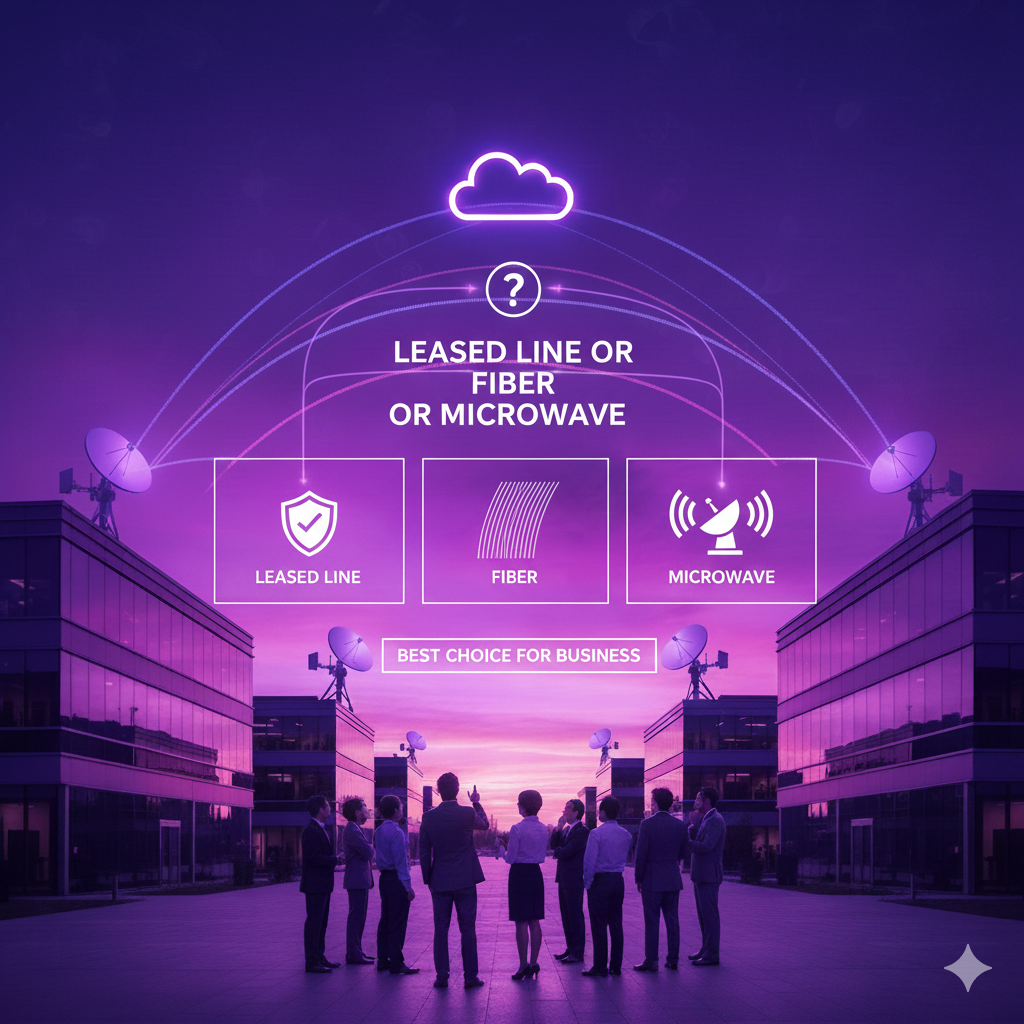
Leased Line or Fiber or Microwave: Best Choice for Business
Article Contents
- Leased Line Connectivity vs Fiber & Microwave Internet: Which Is Best for Your Enterprise?
- Exploring Dedicated Internet Access Services: Leased Line, Fiber Solutions & Microwave Connection
- Fiber Connection Explained: The Gold Standard in Internet Speed
- Microwave Internet: A Practical Alternative to Wired Connections
- How to Select the Best Solution for Your Business Needs
Leased Line Connectivity vs Fiber & Microwave Internet: Which Is Best for Your Enterprise?
Enterprises today rely heavily on stable, high-performance internet connectivity to support cloud applications, video conferencing, remote teams, and mission-critical systems. When evaluating connectivity options, businesses typically compare Leased Line Connectivity, Fiber Solutions, and Microwave Connection technologies. Each option offers unique advantages depending on the environment, geography, and operational requirements.
Leased Line Connectivity provides uncontended, symmetrical bandwidth with guaranteed performance, making it ideal for enterprises requiring consistent speeds and low latency. Fiber Solutions, on the other hand, offer unmatched throughput and scalability, making them the fastest and most future-proof option for long-term digital transformation. Meanwhile, a Microwave Connection provides a reliable wireless alternative-especially valuable for remote areas, rooftop deployments, or locations where fiber installation is not feasible.
Choosing between these options depends on factors such as available infrastructure, business continuity requirements, scalability needs, and budget considerations. Understanding the differences is crucial for enterprises building resilient and efficient connectivity strategies.
Exploring Dedicated Internet Access Services: Leased Line, Fiber Solutions & Microwave Connection
Dedicated Internet Access (DIA) is the foundation of high-performance enterprise networking, and it can be delivered through multiple access mediums-including leased lines, fiber, and microwave. While all three options fall under the umbrella of dedicated connectivity, they function differently.
A Leased Line Connectivity service is a private, point-to-point circuit that guarantees bandwidth availability 24/7. Fiber Solutions deliver DIA using optical technology, supporting multi-gigabit speeds with extremely low latency. A Microwave Connection delivers DIA wirelessly through line-of-sight radio signals, offering fast deployment and robust performance even in hard-to-reach locations.
Key characteristics of DIA across these options:
- Guaranteed bandwidth with no contention
- Symmetrical upload and download speeds
- Business-grade SLAs
Low latency for real-time applications
- High reliability for mission-critical systems
By comparing these access types, businesses can determine which form of DIA best aligns with their operational requirements, geographical constraints, and future growth plans.
Fiber Connection Explained: The Gold Standard in Internet Speed
Among the three technologies, Fiber Solutions are widely considered the gold standard of enterprise connectivity. Fiber uses light to transmit data, allowing it to deliver ultra-fast speeds, near-zero latency, and high-capacity throughput across long distances.
A fiber connection offers:
- Massive bandwidth scalability
- Symmetrical speeds ideal for cloud computing
- Strong resistance to environmental interference
- Exceptional reliability and uptime
- Future-proof infrastructure for next-gen technologies
Fiber is often the top choice for enterprises running large SaaS workloads, video communications, AI processing, big data operations, or multi-cloud ecosystems. Its ability to support heavy, simultaneous traffic makes it a foundational technology for digital transformation.
However, fiber availability may vary by location. In areas where trenching or fiber routes are limited, businesses often rely on Leased Line Connectivity delivered through alternate mediums-or use wireless options like microwave.
Microwave Internet: A Practical Alternative to Wired Connections
A Microwave Connection offers a highly effective wireless alternative, especially in environments where fiber cannot be deployed quickly or cost-effectively. Using point-to-point antennas, microwave links provide dedicated, symmetrical bandwidth comparable to wired DIA services.
Key advantages of microwave include:
- Rapid installation without civil works
- Strong performance for remote or industrial locations
- Resilience in areas with limited wired infrastructure
- High-capacity links suitable for enterprise use
- Effective redundancy when paired with fiber circuits
Many businesses adopt a hybrid model-pairing fiber as the primary link with a Microwave Connection as a resilient backup solution. This creates a highly available architecture that protects against fiber cuts, construction incidents, or carrier outages.
For events, temporary sites, or rapidly expanding facilities, microwave is often the most practical solution due to its speed of deployment and wide coverage potential.
How to Select the Best Solution for Your Business Needs
Choosing between Leased Line Connectivity, Fiber Solutions, and Microwave Connection requires analyzing your enterprise’s technical and operational priorities.
Key selection factors:
- Availability: Is fiber available in your area? Do you need microwave to reach remote or rooftop locations?
- Performance Requirements: Are your workloads bandwidth-heavy or latency-sensitive?
- Budget: Fiber may have higher installation costs; microwave offers cost-effective deployment.
- Redundancy Needs: Many enterprises combine fiber + microwave for high availability.
- Scalability: Fiber offers the greatest long-term expansion capacity.
- Reliability: Leased lines guarantee consistent bandwidth and strict SLAs.
For most enterprises, the optimal approach is a hybrid architecture-leveraging the strengths of all three technologies depending on location and operational needs. The key is selecting a provider that understands how to design, deploy, and manage these connectivity types in harmony.