

Layer 3 MPLS VPN
Routed private connectivity across enterprise sites, with VRF-based separation and CE–PE routing arrangements suited to your network architecture.
Bring your offices, branches, data centres and critical applications together through managed Layer 2 and Layer 3 MPLS services, designed around performance and resilience.
IP4Solutions coordinates international MPLS delivery through carrier relationships, tailoring each service to your routing, resilience and application requirements.
Routed private connectivity across enterprise sites, with VRF-based separation and CE–PE routing arrangements suited to your network architecture.

Ethernet point-to-point or multipoint connectivity, allowing customers to retain control of their own Layer 3 routing and LAN interconnection.

Classification and prioritization of voice, video, transactional and critical applications, subject to the agreed end-to-end carrier service design.

Use private MPLS alongside Internet or cellular underlays, with SD-WAN policy and measured link performance guiding application path selection.
International operations depend on dependable communication between sites, data centres and the applications that keep businesses running. IP4Solutions coordinates carrier-delivered MPLS solutions with the routing, traffic prioritization and resilience requirements of each customer.
Enterprise sites use customer-edge routers and carrier access links to reach provider-edge equipment. Carrier MPLS VPN transport provides L2 or L3 connectivity. SD-WAN edges may establish an overlay across MPLS and other WAN underlays.
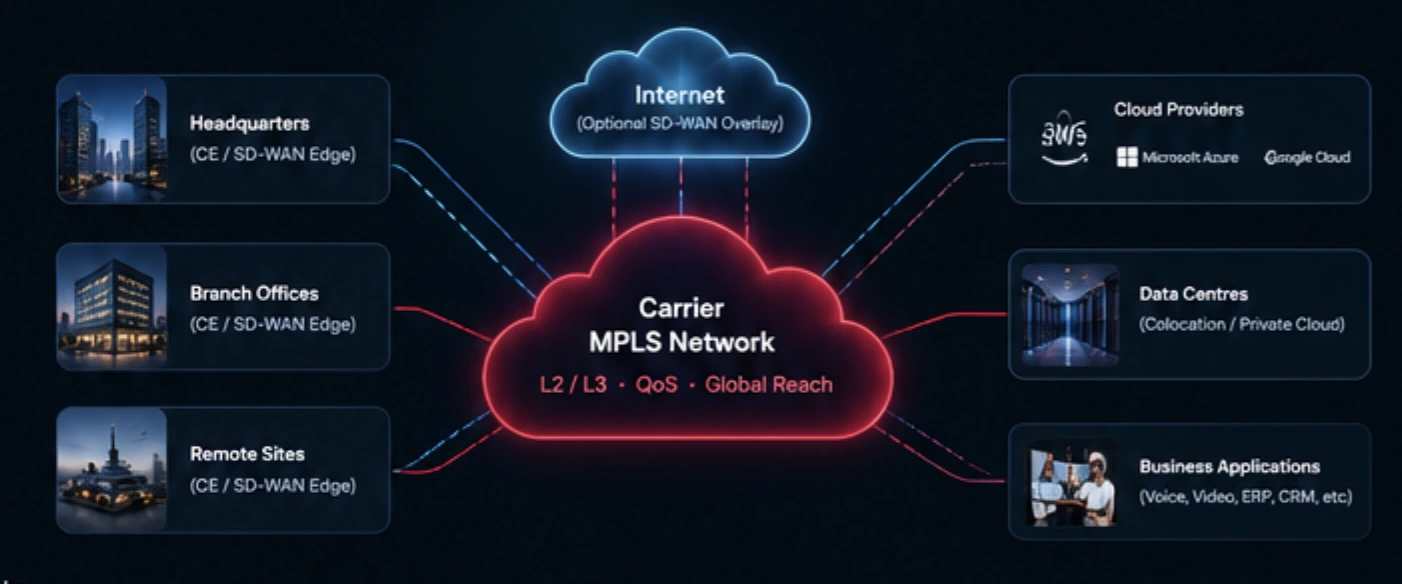
Reference only. Actual provider interconnections, redundancy, security and service guarantees depend on feasibility and contract scope.
IP4Solutions coordinates MPLS through participating carrier and partner networks. These country-level coverage points guide international WAN design; the exact PoP, access facility, NNI, route and service responsibility are confirmed for each customer.
Four strategic European coverage markets.
Nine regional markets for enterprise private WAN requirements.
Nine African markets supported through partner coverage.
Two strategic Asia-Pacific interconnection markets.
United States coverage subject to customer site feasibility.
Partner coverage, not an owned-IP4Solutions PoP list. Exact PoP, access facility, on-net or off-net status and route are validated during service design.
Private branch-to-data-centre connectivity and differentiated traffic for critical applications.
Network connectivity between airport sites, operational locations and airline systems.
Multi-country branch networks with coordinated carrier sourcing and operational management.
Combine private MPLS transport with SD-WAN policies and diverse Internet underlays.
Global MPLS supports international enterprise locations through carrier arrangements and interconnections. Regional MPLS generally covers a smaller geographic footprint. Availability and service responsibility depend on participating carriers.
MPLS VPNs provide logical traffic separation through mechanisms including VRFs and labels. They do not inherently encrypt traffic; encryption can be added where required.
Options may include diverse access circuits, dual routers, redundant provider-edge connections, alternate carriers and SD-WAN failover across MPLS and Internet links.
It can simplify inter-site operations and traffic management, but is not necessarily less expensive than Internet-based alternatives. Compare total costs against required QoS, resilience and coverage.
Layer 2 services transport Ethernet between sites and leave routing to the customer. Layer 3 MPLS VPNs provide a routed WAN with provider participation in routing and VRF separation.
Yes. MPLS may serve as one SD-WAN transport underlay alongside Internet and cellular links. The overlay applies application-aware policies and path selection.
Yes, where supported by contracted service classes and customer equipment. Traffic marking, bandwidth and class mapping must be designed across the relevant network segments.
New branches, offices and data centres can be added to an existing Layer 2 or Layer 3 design, subject to carrier coverage, access feasibility and the agreed routing architecture.
Monitoring can cover latency, jitter, packet loss, utilization and service availability. IP4Solutions can coordinate NOC monitoring and carrier escalation according to the contracted managed-service scope.
Related services: SD-WAN · MPLS-TP · Private Lines & Optical Transport.
Share countries, site addresses, bandwidth, QoS classes and redundancy needs.
Request MPLS Feasibility ↗
The correct answer depends on application behaviour, predictability, security controls, geography, cloud architecture and resilience requirements.
Compare the options →